


How Tax Loss-Harvesting Can Be Beneficial
The goal of Tax-Loss Harvesting is to take advantage of positions that are currently trading below their cost (basis), sell those positions booking a loss and then using that loss to offset or minimize gains on other portfolio gain positions.
At the time that the tax-related loss is booked, it is often prudent to purchase a similar but non-identical position so as not to put the portfolio out of balance. Often times another position, within the same industry, but maybe with better future prospects will be selected. This is important to avoid the “wash sale rule” which prohibits buying back the same security for a minimum of 30-days.
By using this loss against other gains, it will result in lower taxes owed. In addition, you can take losses of up to $3,000/Year against ordinary income. Further any additional losses in excess of the $3,000 noted above can be carried forward indefinitely and used to offset future capital gains.
It is also important to point out that Tax-Loss Harvesting can only be used in taxable accounts. This strategy can not be used on tax-deferred, qualified accounts like 401(k) and/or IRAs.
Tax Loss Harvesting: Simple Examples
Here are a couple of examples illustrating how tax-loss harvesting works.
Example 1: Short-Term Holding Periods
In this example, both Investments A & B had Short-Term Holding Periods. Investment A has $20,000 in capital gains, while Investment B has a $25,000 capital loss.
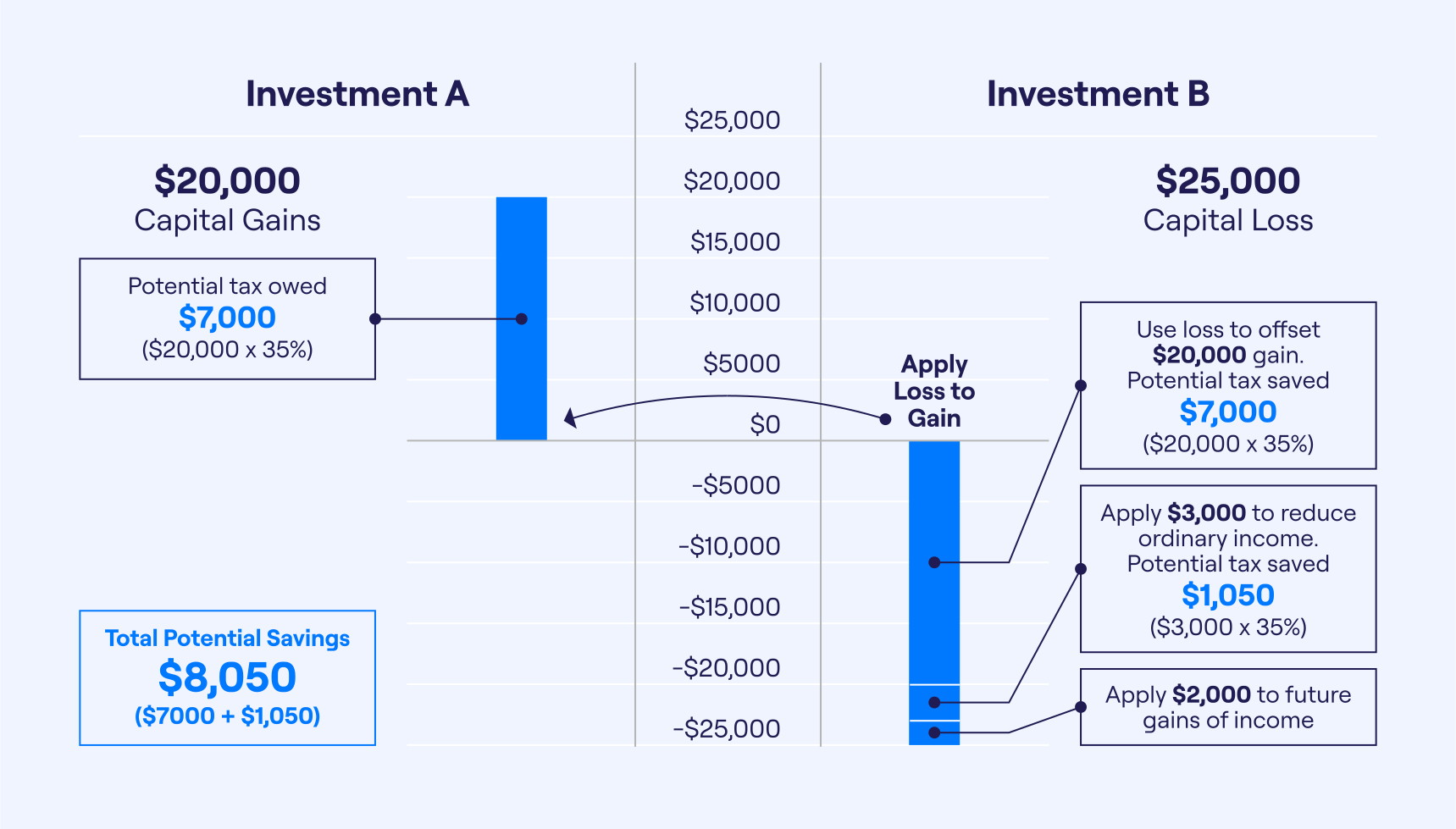
Using an investment loss can lower your capital-gains tax. The loss from the sale of Investment B can be used to offset the gain from sale of A ($20,000). This results in a potential tax saving of $7,000 (based on $20,000 x 35%).
Up to $3,000 in losses can be used to reduce ordinary income. Applying $3,000 of the remaining loss saves a potential $1,050 ($3,000 x 35%).
The remaining $2,000 in losses can be carried forward to apply to future gains or income.
In this example, the total potential tax savings are $8,050 ($7,000 + $1,050).
Example 2: Long-Term Holding Periods
In this second example, both Investments A & B had Long-Term Holding Periods. We assume Tax Rates of 35% for Ordinary Income and 15% for Long-Term Capital Gains. Investment A generates a $30,000 Loss, while Investment B shows a $25,000 Gain.
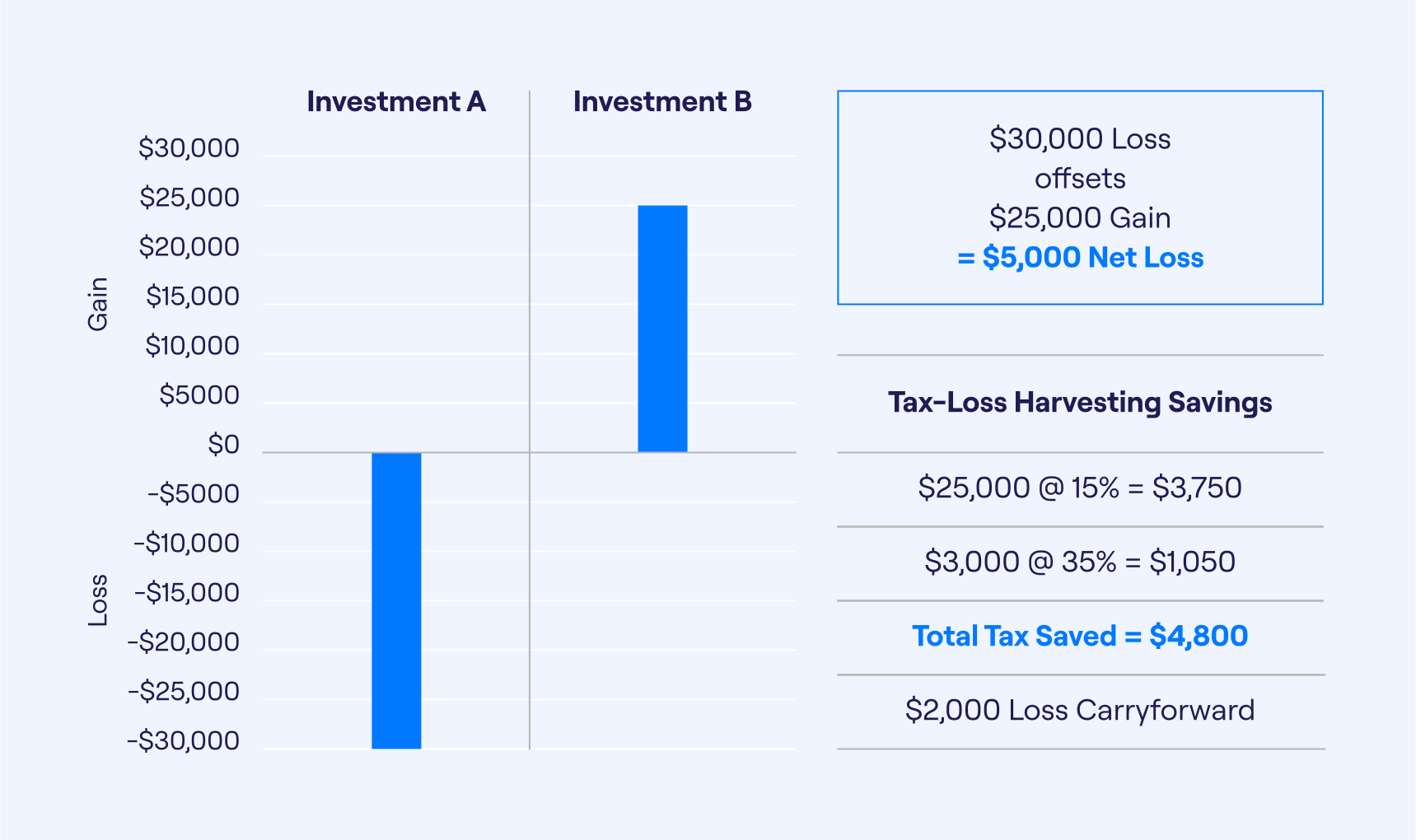
Here, the $30,000 Loss offsets the entire $25,000 Gain. This results in tax savings of $3,750 ($25,000 @ 15%). This leaves a $5,000 Net Loss.
Next, $3,000 of the net loss can be used to offset ordinary income, saving $1,050 ($3,000 @ 35%).
The total tax saved in this scenario is $4,800 ($3,750 + $1,050).
The remaining $2,000 Loss is carried forward.
The Benefits of Tax-Loss Harvesting
There are four main benefits to Tax-Loss Harvesting:
- Lower Taxes paid: losses offset booked gains
- Opportunity to grow portfolio: reinvest tax savings allows for compound growth
- Repair & De-risk: Opportunity to weed out weaker holdings
- Turn Volatility into Opportunity: Lower prices creates opportunity for tax arbitrage
Final Thoughts
As John Maynard Keynes noted, "The avoidance of taxes is the only intellectual pursuit that carries any reward."
And a thought from Mark Twain: "The taxman will take every last thing from you, at least the Taxidermist leaves the outer layer for people to admire."
Ready to start
Open your account in minutes and let our team handle the rest.
